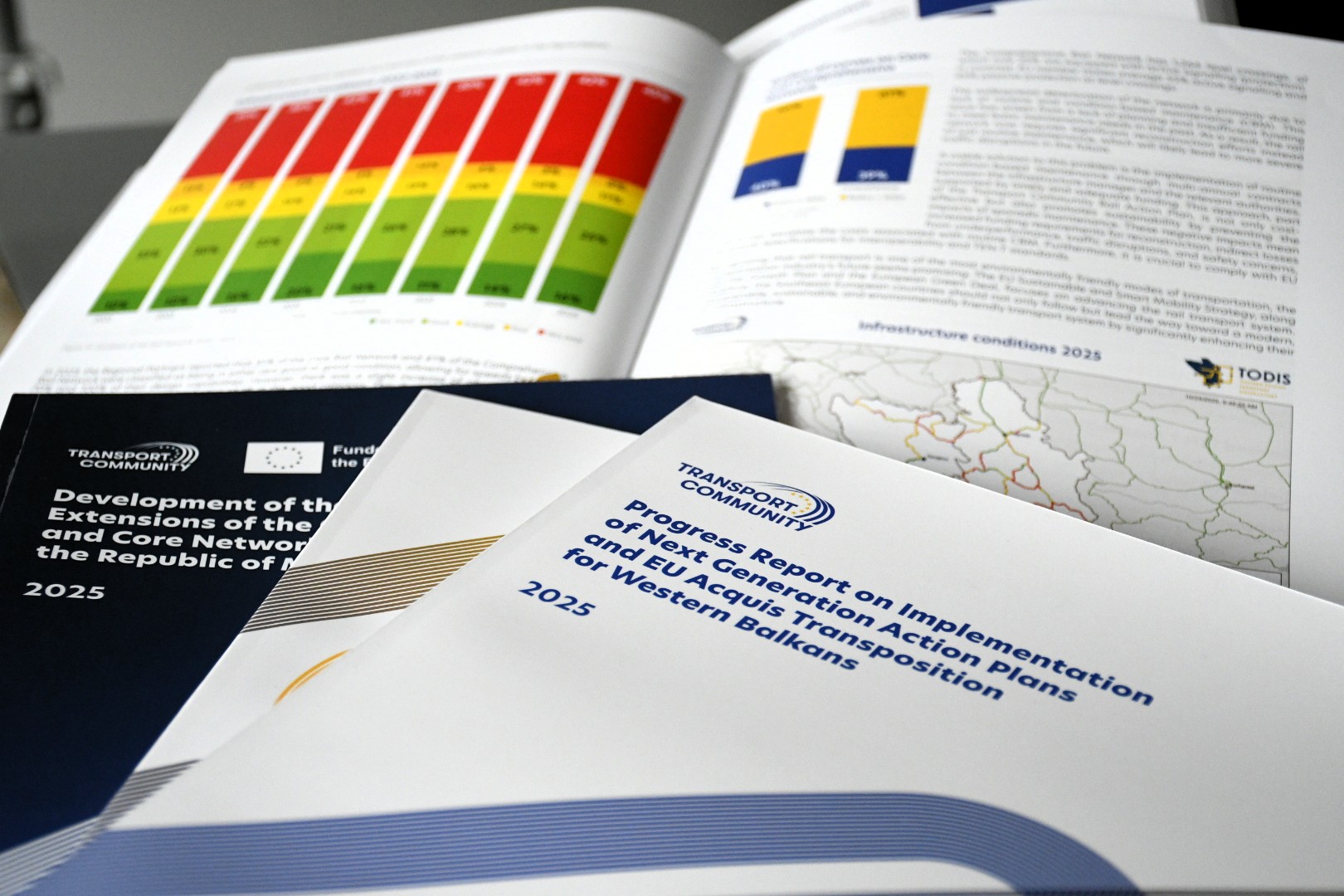
BEGRADE – Following the meeting of the Transport Community’s Ministerial Council, the Permanent Secretariat of the Transport Community publishes four new annual reports that track progress in modernising transport systems across the Western Balkans, Georgia, the Republic of Moldova, and Ukraine.
Together, these four reports present the most comprehensive overview to date of transport reforms, infrastructure performance, and EU alignment across the Western Balkans, Georgia, Moldova, and Ukraine. The reports come at a time when the region is advancing cooperation with the European Union through the Revised TEN-T Regulation, the New Growth Plan for the Western Balkans, and ongoing technical assistance to the observing partners.
2025 Progress Report on Implementation of Next Generation Action Plans and EU Acquis Transposition for Western Balkans
This report outlines how the Western Balkans are advancing on key reforms needed to build smart, sustainable, and resilient transport systems. Covering the period October 2024 to October 2025, it tracks reforms in digitalisation, decarbonisation, rail market opening, and better maintenance of infrastructure. The report highlights notable achievements, such as new railway laws, strengthened rail agencies, significant investments in e-charging stations, and a continued decrease in regional road fatalities. It also recalls major milestones such as the development of 11 priority Green Lanes border crossings and the commitment to intelligent transport systems (ITS). While progress varies across sectors, the message is clear: continued technical assistance and political commitment are essential for aligning with EU standards and fully implementing the Action Plans for 2025–2027.
Read the report here.
2025 Development of the Indicative TEN-T Extension in the Western Balkans
The second report presents, for the first time, a set of Key Performance Indicators aligned with the EU’s revised TEN-T Regulation. These new indicators go beyond measuring what has been built: they assess safety, digitalisation, sustainability, and the quality of connections between transport modes. The report shows that the Core Road Network has improved but still needs more investment in modern safety features and better data collection. Railways show signs of revival, with higher speeds and more ERTMS deployment, yet almost half of the lines are still in poor condition. Waterborne and air transport continue to improve, especially in ports and airport connectivity. Massive investment across the region, including €2.8 billion in rail projects and €10.5 billion in road projects, demonstrates a strong push to modernise the network, though maintenance must become a long-term priority.
Read the report here.
2025 Progress Report on Implementation of TCT Action Plans for Georgia, Moldova, and Ukraine
This report assesses how the three Observing Participants are advancing transport reforms and transposing EU legislation. Despite different starting points and challenges, including the impact of Russia’s war of aggression against Ukraine, all three partners are taking steps toward EU alignment. Georgia shows solid progress, particularly in road safety and infrastructure management. Moldova advances more slowly due to institutional and capacity gaps, especially in multimodality and road safety, while Ukraine has recently re-engaged in waterborne transport reforms and set clearer priorities for 2026. Overall, implementation of the four Action Plans (Rail, Road, Road Safety, and Waterborne Transport) is moderate, with an average completion rate of 39%. However, legislative alignment remains limited, with more than 65% of the EU transport acquis still not transposed across the three partners.
Read the report here.
2025 Development of the Indicative TEN-T Extensions for Georgia, Moldova, and Ukraine
The final report shows only modest progress since last year, driven mostly by updates to the TEN-T maps rather than major infrastructure upgrades. Large differences remain between the three observing particiapnts’ transport systems. Georgia has a fully electrified rail network but limited train lengths and slow speeds; Moldova needs major investments in electrification, rail modernisation, and ITS systems; while Ukraine, despite wartime conditions, maintains some of the region’s best rail performance indicators and has begun work on adapting track gauge to EU standards. In road transport, the observing participants face maintenance challenges and gaps in alternative fuel infrastructure. Ports are expanding digital systems and multimodal connections, but environmental and alternative fuel facilities remain scarce. Airports in Georgia and Moldova perform well in capacity and connectivity, but none of the three observing participants currently meet EU requirements for aviation biofuels and alternative fuels.
Read the report here.