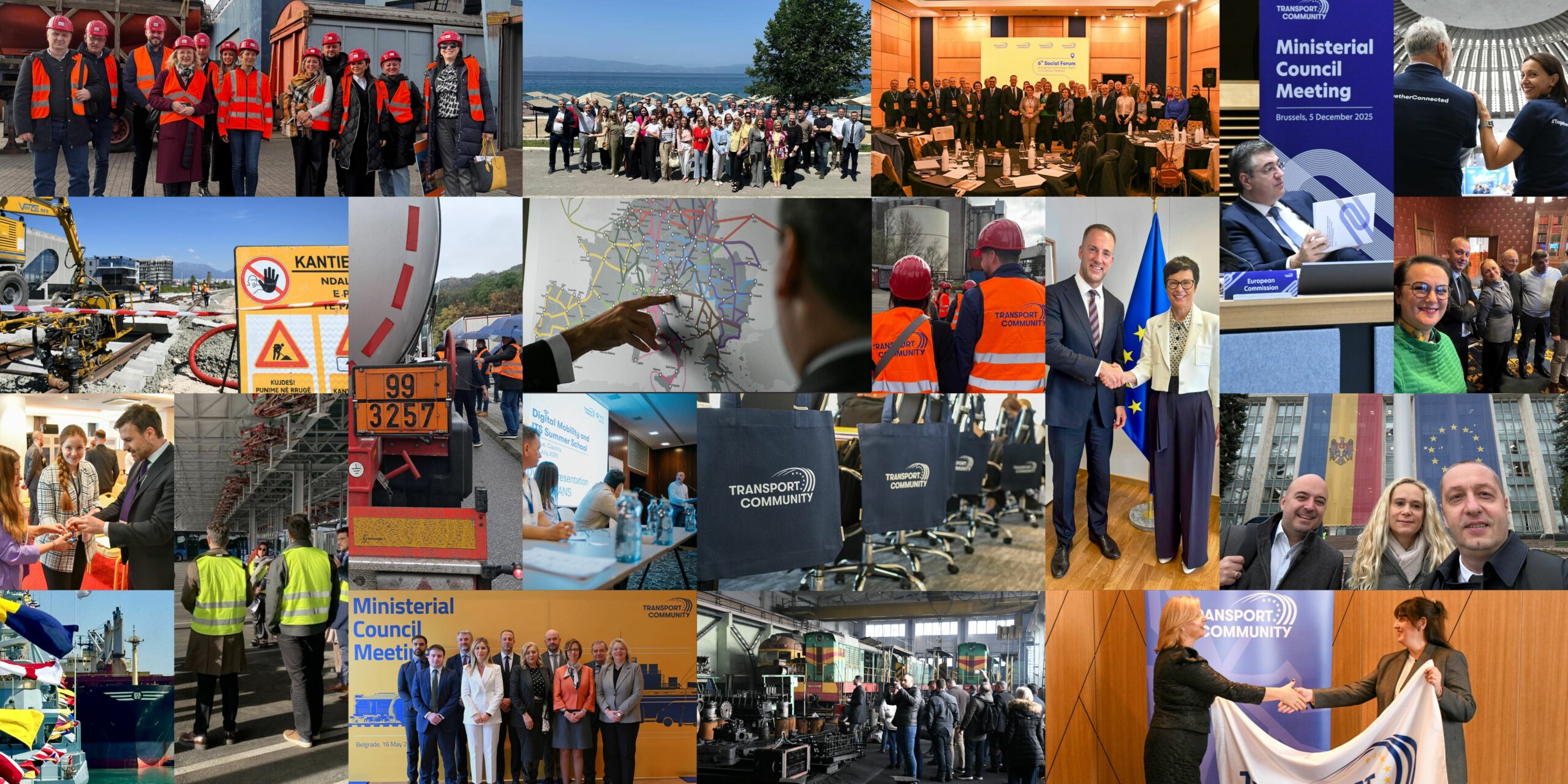
It is that moment of the year when reflection comes naturally, both personally and professionally. For the Transport Community, 2025 was a year of consolidation and steady navigation, set against a backdrop of global political uncertainty and, at times, open hostility. It marked the sixth year of fully independent functioning and a year in which the course was not changed, but stabilised.
By 2025, what was once a young regional initiative had become a respected international institution. The challenge was no longer to prove its relevance, but to sustain credibility and deliver under rising expectations. Those expectations increased sharply across the Western Balkans, among observing participants, and within the European Union, while the political and economic environment became more demanding.
This was particularly evident at the political highlight of the year, the Ministerial Council in December. In six years, the Transport Community had grown into a respected and authoritative organisation, recognised not only for the quality of its outputs but also for its standards. The volume of technical work, training, capacity building, reports and assistance continued to grow, but more importantly, the work delivered. Integration into the EU transport market ceased to be a distant objective under the Treaty. It became a practical reality, acknowledged in the European Commission’s annual progress reports and confirmed by independent assessments.
European rules, methods, and benchmarks were no longer abstract references. They were applied and measured through concrete reporting in the Progress Report on Implementation of Next Generation Action Plans and EU Acquis Transition for the Western Balkans. As of 2025, 17 per cent of EU transport legislation had been fully transposed, and 31 per cent had been partially transposed. At the same time, 52 per cent of the EU transport acquis remains to be adopted, underlining the scale of work ahead.
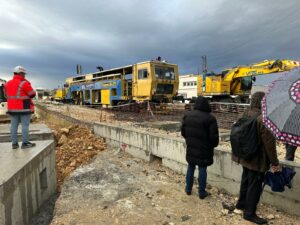
In 2025, tangible progress was recorded in connectivity, as outlined in our Report on the Development of Indicative TEN-T Extension of Comprehensive and Core Networks in the Western Balkans, with projects completed across all transport modes. For example, on the Belgrade–Niš railway and the Niš–Dimitrovgrad section in Serbia towards Bulgaria, electrification and modernisation works advanced on Corridor X, directly improving cross-border rail performance. Upgrades on Corridor VIII between Tirana and Durrës, alongside continued works on the Bar–Belgrade railway, strengthened links between Adriatic ports and the core European network, turning long-planned corridors into operational assets. Despite significant EU funding, a substantial financing gap remains, and cost overruns have raised concerns about the region’s capacity to meet both current and future investment needs. In the coming year, strategic prioritisation will be essential to optimise resources and maximise economic returns.
Border procedures also improved through work carried out under the Green Lanes initiative steered by the Transport Community and CEFTA. New bilateral agreements were signed, including between Greece and Albania, Bulgaria and North Macedonia, and Italy and Serbia. Citizens experienced tangible benefits, including safer roads, shorter waiting times, and more predictable transport flows. This was an enlargement in practice, measurable and real. In parallel, the European Commission allocated €54 million to improve 11 of the busiest border-crossing points for business, an investment whose impact should become visible in the coming period.
The year also confirmed that the Treaty had evolved beyond its original scope. The Transport Community was created to support the integration of the Western Balkans into the EU transport network and the TEN-T. By 2025, it had become an organisation whose quality of work serves as a model of transport market integration, attracting partners beyond the Western Balkans. Ukraine, the Republic of Moldova and Georgia were no longer peripheral observers, but active participants increasingly embedded in our daily work. Their presence reflected a broader reality: connectivity has become geopolitical. Transport corridors are no longer merely regional projects but strategic assets for people-to-people contact, the economy, and even military mobility.
Consolidation under these conditions was a normal process, but not an easy one. Demand for more work, more reports, more training and more capacity building continued to grow. At the same time, resources remained unchanged for five consecutive years, and inflation steadily eroded every budget line, from seminars to meetings and events. Yet the organisation absorbed complexity without downsizing its capacity-building programmes. Budget execution speaks for itself, rising from 34 per cent in 2020 to 97 per cent in recent years, supported by five independent audit reports, all of which confirm a clean bill of health.
What also stood out in 2025 was the absence of hierarchy around the table. This was particularly visible during the two Ministerial Councils held this year, in May under the Serbian Presidency in Belgrade and in December under the Albanian Presidency in Brussels. EU member states and candidate countries sat as equals, facing the same challenges and opportunities.
That said, reforms can and should go further; projects could be implemented faster. Delays in project implementation must be avoided rather than explained. Citizens rightly expect faster and (even) more visible results. For example, in road safety, progress will only be satisfactory if there are no serious injuries or fatalities on our roads. The latest figures published by the Secretariat show only modest improvement. In 2024, the Western Balkans recorded 1,225 road traffic deaths, down 2.9 per cent from 1,261 in 2023. Since 2019, fatalities have fallen by 6.8 per cent. While encouraging, this pace of improvement remains insufficient to meet the region’s target of halving road deaths and serious injuries by 2030.
By December, reflection became both personal and institutional. The closing of the Ministerial Council marked the final such meeting under my directorship of the Secretariat; two mandates of six years in total. What was reconfirmed for me at that moment is that the EU enlargement process, when handled honestly and with the right momentum, remains one of the European Union’s most powerful instruments, not as an abstract promise or a technical exercise, but as a daily mechanism for improving lives for candidates and for the EU member states.
The Transport Community demonstrated that integration works when it is operational and grounded in tangible outcomes: when it builds railways, improves border crossings, enhances road safety and creates predictability through shared rules and standards. The road/rail ahead remains long, and consolidation is not an end state. Pressure will not diminish, but I am confident that the next leadership will bring new energy and new ideas. Institutions that matter must renew themselves, and this is true for the Transport Community as well.
As the year closes, there is confidence without complacency, and a simple conviction that Europe, where transport truly connects us, is not a slogan but a responsibility. A place where we are, as we say in the Transport Community, truly #TogehterConnected.
Season’s greetings, and a peaceful and prosperous New Year!
Matej Zakonjšek