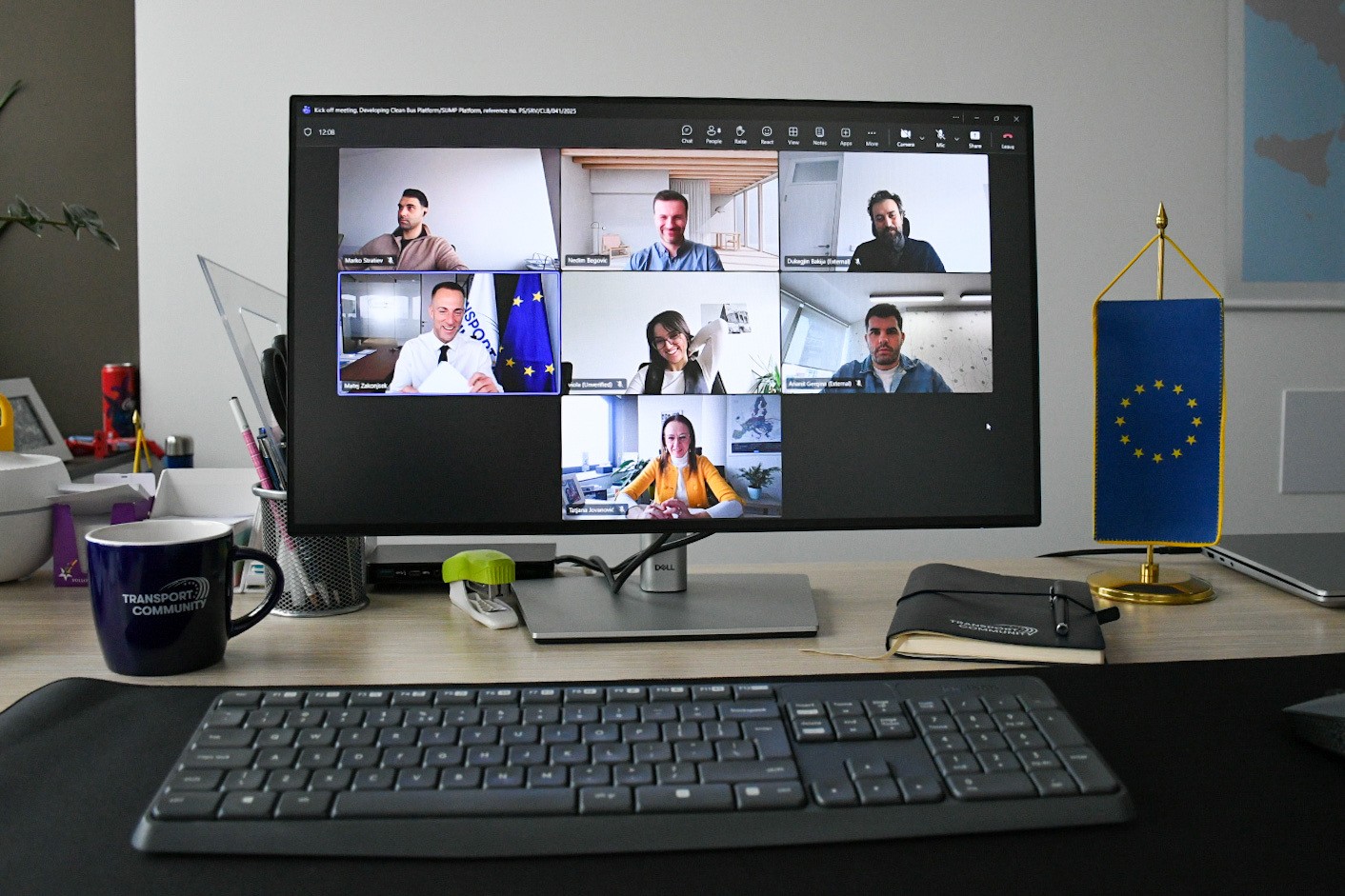
BELGRADE – The Permanent Secretariat of the Transport Community today officially launched technical assistance on Clean Bus / Sustainable Urban Mobility Plan (SUMP) Platform with an online kick-off meeting, marking the start of a new regional project to support zero-emission urban transport and modern mobility planning across the Western Balkans.
Opening the meeting, Director of the Permanent Secretariat of the Transport Community, Mr Matej Zakonjšek, underlined that the project directly responds to both regional commitments on clean mobility and evolving European transport policy requirements.
“Urban nodes are becoming central to Europe’s transport policy. With the revised TEN-T Regulation, cities are expected to deliver Sustainable Urban Mobility Plans, zero-emission fleets, and measurable performance monitoring by 2030 and beyond. The Western Balkans must move in the same direction to remain competitive, sustainable, and fully aligned with the EU transport acquis,” Mr Zakonjšek said.
The Clean Bus / SUMP Platform will design, build, and operationalise a regional digital platform to support deployment of zero-emission bus fleets, including electric and other alternative fuel technologies, systematic monitoring of Sustainable Urban Mobility Plans (SUMPs) aligned with EU standards, a harmonised data ecosystem covering fleet decarbonisation, alternative fuel infrastructure, and SUMP implementation, and a regional collaboration hub for knowledge sharing, capacity building, and transparency of results.
By creating a unified digital infrastructure, the project will address a key gap in the region: the absence of a shared system to collect, visualise, manage, and compare clean bus and urban mobility data.
The project is expected to deliver tangible benefits across the Western Balkans such as evidence-based policy support through reliable and comparable data aligned with EU benchmarks, enhanced regional coordination among ministries, municipalities, operators, and financiers, capacity building via shared tools, training modules, and a digital knowledge hub, and performance transparency through interactive dashboards and public progress indicators.
These tools will help authorities design stronger strategies, attract financing, and demonstrate progress to EU institutions, partners, and citizens.
The project will be implemented in close cooperation with the contracted technical team, national authorities, cities, urban mobility stakeholders, and financing partners. Its success will depend on strong coordination, shared priorities, and a commitment to deliver results across the region.