When I arrived in Belgrade in August 2020 as the first Director of the Permanent Secretariat of the Transport Community, the institution was still young. The COVID pandemic was reshaping Europe, regional cooperation was under pressure, and many of the structures we now take for granted were still in their early stages.
Six years later, the Transport Community is no longer a new institution searching for its place. It has become a recognised and credible platform for advancing transport integration between the European Union and the Western Balkans. More importantly, it has become a practical instrument of European integration.
Our mission was always relatively easy to explain and considerably harder to deliver: bringing the Western Balkans closer to the EU transport market and network through alignment of rules, better infrastructure, stronger institutions and practical cooperation.
Simple in concept, considerably more demanding in reality.
These six years also coincided with a period of profound change across Europe and beyond. Geopolitical tensions returned to the centre of policymaking. Supply chains became strategic considerations. Connectivity itself evolved from being viewed primarily as infrastructure policy into something much broader: resilience, competitiveness, economic security and strategic positioning.
Transport increasingly became part of geopolitics, while geopolitics increasingly shaped transport policy.
Against that backdrop, important progress was made. The revised TEN-T framework integrated the Western Balkans into the new Western Balkans–Eastern Mediterranean Corridor, finally moving the region away from the perception of being a blank space on Europe’s transport map.
That mattered not only because of infrastructure planning. It sent a broader message that connectivity does not stop at EU borders. Europe is strongest when networks extend beyond borders and when integration is translated into practical outcomes.
Looking back, I believe one of the most important achievements of recent years has been the gradual emergence of a stronger regional mindset. Cooperation that often remained bilateral increasingly became multilateral, and transport slowly moved from being viewed as a series of national infrastructure projects towards a shared regional agenda.
Another important success story has been the growing engagement of the Transport Community Observers. Moldova, Ukraine and Georgia brought an additional strategic dimension and broader European perspective to our work. Their engagement has enriched discussions, strengthened cooperation and demonstrated that practical integration can gradually evolve into a deeper institutional partnership, hopefully paving the way towards full membership.
The Green Lanes initiative remains one of the clearest examples. Launched during the pandemic together with regional and European partners as an emergency response measure, it evolved into one of the most practical demonstrations of what regional cooperation can deliver. Through reduced waiting times and more efficient procedures, Green Lanes have saved nearly twenty years of cumulative waiting time at border crossings. That number matters because behind it stand businesses, drivers, supply chains and citizens whose daily lives depend on predictability and efficiency. More importantly, Green Lanes demonstrated a broader lesson: borders do not have to function as bottlenecks. With sufficient trust, coordination and political commitment, they can become gateways.
The Secretariat itself also evolved considerably over these years. We strengthened technical committees, observatory functions, reporting mechanisms, data systems and regional coordination structures. Monitoring became stronger, reporting more systematic, and political ambition increasingly translated into measurable delivery. The institution gradually evolved from a coordination platform into an implementation-oriented organisation because implementation is ultimately where integration becomes real.
One lesson repeatedly emerged throughout this mandate. Corridors are not simply lines on maps. They are systems that require infrastructure, governance, procedures, institutions, digitalisation, and trust. Infrastructure creates potential, but soft connectivity creates results.
This became one of the defining ideas underpinning my mandate and increasingly one of the central messages of the Transport Community itself.
At the same time, honesty matters. The region still faces significant challenges. Too much EU transport legislation remains only partially implemented. Border crossings continue to undermine competitiveness, rail reform is underway but not yet at the required pace, and progress remains uneven across sectors and partners.
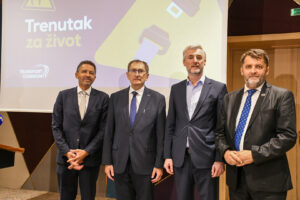
Road safety remains one of the clearest examples. Preliminary data for 2025 show continued improvements across the Western Balkans, but progress remains below the trajectory required to achieve our shared objective of halving road fatalities by 2030. Behind every number stands a person, a family and a preventable tragedy. Transport policy is often reduced to infrastructure plans and investment figures, yet ultimately it is also about protecting lives.
Perhaps this is the central lesson I take from these six years: infrastructure without reform is not enough, and reform without implementation remains only paper with better formatting. Europe is built through rules, institutions, budgets, persistence and trust, and occasionally, after very long Ministerial Council or Regional Steering Committee meetings, also through coffee.
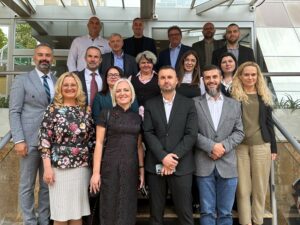
None of what has been achieved over these years was ever an individual effort. People ultimately build institutions. I have been fortunate to work with extraordinary colleagues at the Secretariat whose dedication regularly exceeded formal responsibilities. Behind every Ministerial Council, every Regional Steering Committee, every Technical Committee meeting, every report, mission, negotiation and initiative stood colleagues whose names rarely appear publicly, but whose work made progress possible. For that, I want to express my deepest gratitude to all colleagues at the Secretariat, past and present. To technical experts, policy colleagues, legal teams, communications staff, finance and administration colleagues, and everyone who contributed to strengthening the institution year after year.
I would also like to thank our partners across the region of the Western Balkans, as well as observers, the European Commission (particularly DG MOVE and DG ENEST), Member States, the EIB, the EBRD, the World Bank, CEFTA, RCC and many others who accompanied us on this journey. Regional cooperation never happens automatically. It requires patience, persistence, and, above all, trust.
For me personally, this mandate became much more than a professional role. It became a European journey in the most practical sense: working with ministers, engineers, experts, railway professionals, border authorities, financial institutions and colleagues across the region to make integration tangible.
Transport connects people. But in the Western Balkans, transport also tests trust.
And trust, in many ways, is infrastructure too.
Looking back, I leave with gratitude, pride and optimism for what comes next. I leave convinced of one thing: enlargement is not built in conference rooms or declarations. It is built at border crossings, railway stations, ports, logistics terminals and roads. It is built every time systems become more compatible, procedures more predictable, and citizens move more easily.
The work is far from finished, but the direction is clear.
At the end of this road, the journey continues.
And perhaps that is what the Transport Community has always tried to demonstrate: progress happens when regional partners, EU Member States, institutions and people move #TogetherConnected.
Matej Zakonjšek
Director
Permanent Secretariat of the Transport Community